








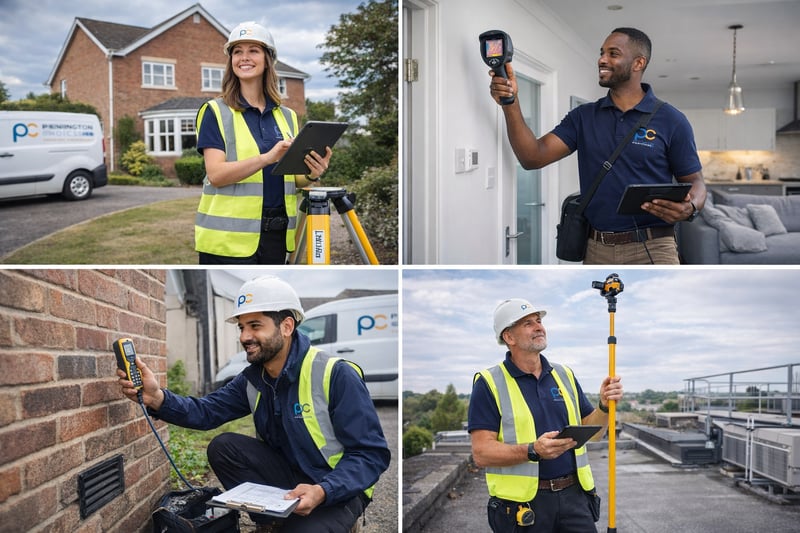
Your housing provider has asked Pennington Choices to carry out either a survey, assessment, or audit on their behalf; your appointment letter will specify which one.
Our trained and experienced surveyors and assessors visit residents' homes to look at the building, identify any issues, and assess its condition and safety.
We are not here to inspect you or judge how you live in or look after your home. Our visit is focused on the building and the specific inspection we have been asked to carry out. You can find out more about this below.
What happens during the visit will depend on the type of inspection your home needs.
During most visits, our surveyor will look around your home, take photos, and make notes about the condition of the building and its fixtures and fittings.
Please ensure any required parking permits are available for our surveyor, if available.
Our surveyors are professional and respectful of your home and operate with minimum disruption. You do not need to tidy or prepare for the visit, however, please make sure the surveyor can access the areas they need to inspect.
Select your inspection opposite to find out more about what will happen during the visit.
An asbestos survey checks whether materials in your home may contain asbestos. Finding asbestos does not always mean it must be removed. If it is in good condition and will not be disturbed, it can often be safely left in place and monitored.
We may look at:
The surveyor will need to take photographs to record which areas were checked.
Asbestos sampling: If we find a material that may contain asbestos, we will take a small sample for laboratory testing. This will be sent to our laboratory to check whether asbestos is present. The surveyor will make sure the area is safely cleaned and sealed after any required sampling. The sample will be taken as discreetly as possible and leave the area safe and sealed.
Typical visit time: 60 minutes – 90 minutes. The time may vary depending on the size and layout of your home.
A Damp and Mould Survey checks for signs of damp and mould in your home and helps us understand what may be causing it.
We may look at:
The type of survey will depend on the issue your housing provider has identified and the information available. There are three levels of inspection:
Typical visit time: 45 minutes – 1 hour
A Stock Condition Survey checks the condition of the different parts of your home to help your housing provider understand when they may need to be replaced.
We may look at:
Typical visit time: 20 – 45 minutes
An Energy Performance Certificate (EPC) Assessment looks at your home to understand how energy efficient it is and what could make it more energy efficient.
We may look at:
Typical visit time: 20 – 45 minutes
A Fire Risk Assessment checks the fire safety of your home and/or the building and whether people can safely escape in the event of a fire.
There are different types of Fire Risk Assessment, so what we look at will depend on the assessment being carried out.
Type 1: We will look at the shared areas of the building, such as corridors, stairways, entrances, loft spaces, and service risers. We may also check your flat entrance door.
Type 2: We will check the same things as in a Type 1 assessment but may also involve opening up of parts of the building to inspect fire safety features that are not visible, including inspecting inside walls, ceilings, or floors.
Type 3: We will check the communal areas of the building and some individual homes to look at:
Type 4: We will carry out the same checks as a Type 3 assessment but may also need to open up parts of the building and your individual home. This could include making small inspection openings in walls, ceilings, or floors. If this is needed, it will be carried out by suitably qualified contractors.
Typical visit time: Will vary depending on the building and extent of the inspection.
A Fire Compartmentation Survey checks the parts of your building that are designed to stop fire and smoke from spreading. In some cases, the inspection may involve opening up parts of the building so we can check what is behind walls, ceilings, or floors. If this is needed, your housing provider will arrange for a contractor to carry out the opening up. Pennington Choices will not be responsible for opening up or making good any areas afterwards, this will be dealt with by your housing provider.
We may look at:
Typical visit time: Will vary depending on the building and extent of the inspection.
A Gas Safety Audit checks that gas safety work and records for your home have been completed correctly.
We may look at:
Typical visit time: 45 minutes – 1 hour
An Electrical Safety Audit checks that electrical safety work in your home has been completed correctly and that the information recorded about it is accurate.
We may look at:
Typical visit time: 45 minutes – 1 hour
Check your appointment letter, text, or email or contact your housing provider to find out.
Browse the frequently asked questions below to find your answer:
Your housing provider has asked Pennington Choices to carry out an inspection of your home. The inspection helps your housing provider understand the condition and safety of your home and identify any issues that may need attention.
One of our surveyors will visit your home to carry out the inspection.
Pennington Choices works with housing providers across the UK to carry out inspections of their homes. Your housing provider has asked us to carry out the inspection at your property.
Your housing provider will be able to explain the access requirements that apply to your home. These can vary depending on your tenancy agreement and the type of inspection being carried out.
If you have concerns about allowing us access, please contact your housing provider.
The length of the visit depends on the type of inspection being carried out. Most inspections take around 45 minutes to 1 hour.
You can find more information about the expected time for each type of inspection in the 'What will happen during the visit?'.
No, you do not need to clean or tidy your home before we visit. We are not here to inspect you or judge how you live in your home. Our visit is focused on the property and the specific inspection we have been asked to carry out.
If you cannot be at home at the time of your appointment, please contact 0800 883 0334 as soon as possible.
Please let us know about any accessibility requirements when arranging or confirming your appointment. We will do our best to make sure the inspection is accessible and comfortable for you.
If you have already received an appointment and need to discuss an accessibility requirement, please contact 0800 883 0334.
Please keep pets in a separate room, on a lead or in a secure crate while our surveyor is in your home.
This helps to keep your pet, you and our surveyor safe and allows the inspection to be completed without disruption.
Yes. Our surveyor may take photographs of relevant areas of your home as part of the inspection.
The photographs help us record what we find and allow our experts to assess the condition and safety of your home. They may also be included in the information we provide to your housing provider.
Pennington Choices works with the Scottish Government to support the Warmer Homes Scotland scheme and with the Welsh Government to support the Warm Homes Wales scheme.
These schemes provide support to households to help improve energy efficiency, stay warm and manage energy costs. If you live in Scotland or Wales, your housing provider may have asked us to carry out an inspection as part of one of these schemes.
Most inspections are visual, which means we will look at the property without making holes or causing damage.
For some inspections, we may need to take a small sample or make a small opening to check something that cannot be seen. This can include certain asbestos surveys or Type 3 or Type 4 Fire Risk Assessments.
If this is needed, our surveyor will explain what they need to do before carrying out the work.
We will only need to move furniture if it is blocking an area that we need to inspect, such as a window, wall or boiler.
Our surveyor will only move items where necessary and will take care around your belongings.
Yes, someone aged 18 or older will need to be at home for the inspection so that our surveyor can access the areas they need to inspect.
Please make sure someone is available for the full length of the appointment.
The results of the inspection will normally be provided to your housing provider. Your housing provider will decide what action needs to be taken based on the findings.
If you have questions about the results or any work that may be needed in your home, please contact your housing provider.
No. Our job is to inspect your home and identify any issues that may need attention.
If the inspection identifies something that needs to be repaired, your housing provider will arrange for the necessary work to be carried out.
Your safety is important to us, as well as our surveyors. Our surveyors will carry company identification and will be able to explain who they are and why they are visiting.
Before allowing someone into your home, you can:
Do you need to rearrange your appointment?
Contact us at 0800 883 0334
| Who are we?
We are an independent property consultancy and surveying company. We work with housing providers across the UK to carry out important inspections of homes.
Our inspections help housing providers understand the condition and safety of their properties and identify any issues that may need attention.


A Pennington Choices surveyor will visit your home during the appointment time you have been given.
Our surveyors will:
If you have any questions about the inspection while our surveyor is in your home, please ask them. They will be happy to explain what they are doing and why.
Learn more about how your housing provider keeps you and your home safe.

Think you know about asbestos? Take our quiz to find out just how much you know – from prohibition regulations to properties of asbestos.
Take the quiz

We’ve come up with 4 things you probably didn’t know about asbestos, and how our services can help you manage this harmful material.
Read now

Explore the rising fire safety risks of lithium-ion batteries, including the causes, prevention strategies, and essential safety measures for buildings.
Read Now

Discover expert answers to frequently asked gas safety questions, covering accessing properties, gas capping, and the MOT style of gas servicing.
Read now