.webp?width=600&height=150&name=Pennington%20Choices%20Logo%20(reduced).webp)



Speak to our team
Looking for support with ensuring the safety and compliance of your buildings? Get in touch with our team of experts.

Share this article


With the Hazards in Social Housing (Prescribed Requirements) (England) Regulations 2025, also known as Awaab’s Law, introducing a fundamental shift across social housing regulation, it can be difficult to stay on top of the prescribed timescales that you need to address hazards within and how these have evolved with the latest guidance update.
To help you navigate the changes more effectively, our experts have broken down the key timescales that you need to understand into easily digestible diagrams that will help you implement the new requirements in practice.
 To find out more about the latest Awaab's Law Phase 2 guidance, download our free Housing Provider's Guide to Awaab's Law Phase 2 to discover everything you need to know, including how to strengthen hazard triage, tenant communication, and record-keeping in line with the new requirements.

Awaab's Law Process Flow
Categorising emergency, significant, and out of scope hazards
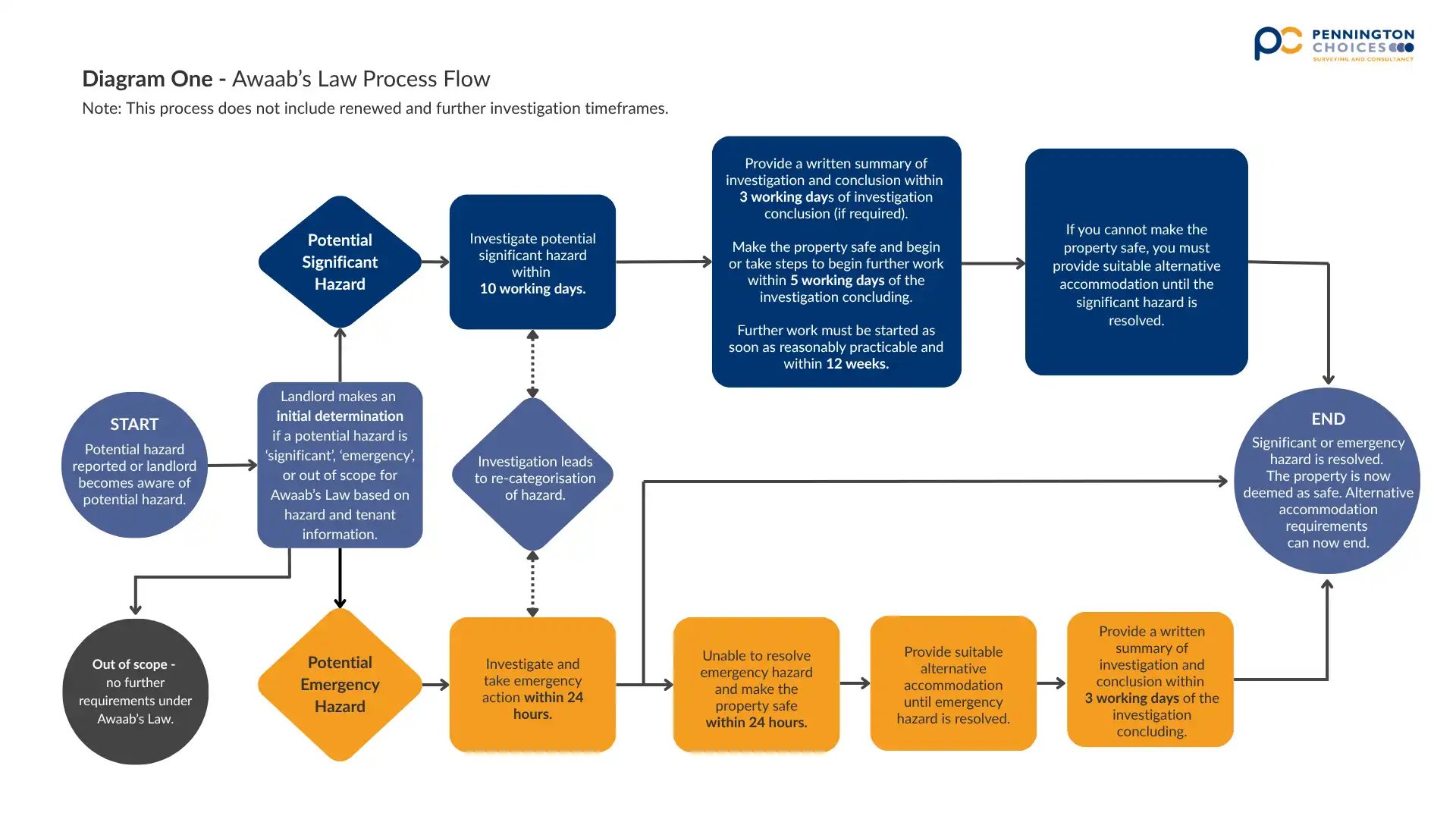
Diagram one shows a simplified process flow to demonstrate how Awaab’s Law timescales operate when resolving a significant or emergency hazard.
Example renewed investigation .webp?width=1920&height=1080&name=Awaabs%20Law%20Timelines%20and%20Examples%20in%20Practice%20-%20Pennington%20Choices%202026%20(1).webp)
Diagram two is a hypothetical scenario of a renewed investigation; it is not demonstrative of all possible circumstances and should not be relied upon exclusively for understanding the requirements.
Examples of Awaab's Law in practice
The updated 2026 Awaab’s Law guidance that was published in preparation for Awaab’s Law Phase 2 included further practical examples to illustrate how the Awaab’s Law timescales operate. These examples are designed to clarify when the various timescales are activated and to demonstrate which requirements run concurrently with others.
We have picked out three of the key examples that will help you understand how investigations should work in practice to meet the required timescales, including a standard investigation, renewed investigation, and an emergency investigation. For further examples that relate to more specific investigations, you can access the full government guidance here.
Standard investigation
.webp?width=1920&height=1080&name=Awaabs%20Law%20Timelines%20and%20Examples%20in%20Practice%20-%20Pennington%20Choices%202026%20(3).webp)
Diagram three shows a standard investigation, which takes place on working day 10 and finds a significant hazard. The property must be made safe within 5 working days of the investigation concluding at the latest, and the written summary must be issued within 3 working days of the investigation concluding.
In addition to this, you must begin, or take steps to begin, any supplementary preventative works to prevent the significant hazard recurring within 5 working days of the investigation concluding.
Renewed investigation
.webp?width=1920&height=1080&name=Awaabs%20Law%20Timelines%20and%20Examples%20in%20Practice%20-%20Pennington%20Choices%202026%20(4).webp)
Diagram four shows a scenario where a resident reports a hazard to their landlord (day 0). In this scenario, the landlord conducts a standard investigation on working day 6 by analysing photos provided by the tenant which concludes that the hazard is out of scope of Awaab’s Law.
You would then inform the tenant in a written summary (via email) 1 working day after the investigation concludes. The resident is dissatisfied with the outcome and requests the landlord to investigate in person, the same day as receiving the written summary (working day 8). The renewed investigation takes place on working day 4 and concludes that there is a significant hazard. This means that the property must be made safe within 5 working days of the investigation concluding, and the written summary must be issued within 3 working days of the investigation concluding.
You must then begin, or take steps to begin, any supplementary preventative works to prevent the significant hazard recurring within 5 working days of the renewed investigation concluding.
Emergency investigation with supplementary preventative works
.webp?width=1920&height=1080&name=Awaabs%20Law%20Timelines%20and%20Examples%20in%20Practice%20-%20Pennington%20Choices%202026%20(5).webp)
Diagram five shows a tenant has reported a hazard, and the landlord has reason to believe there is an emergency hazard. You must conduct an emergency investigation and make the property safe within 24 hours.
The hazard requires further repairs and therefore the landlord must begin, or take steps to begin, any supplementary preventative works to prevent the hazard recurring within 5 working days of the investigation concluding.
The written summary must be issued within 3 working days of the investigation concluding, unless all supplementary preventative works are completed before this point.
Following the influx of questions we received during our recent webinar, ‘Awaab’s Law Phase 2: What to expect’, Jordan Brown, Head of Consultancy, Ben Davidson, Head of Survey Services, and Stewart Kerr, Principal Consultant, have compiled and answered the remaining questions from the session. Their expert answers cover topics including whether there is a one-size-fits-all approach to navigating Awaab’s Law Phase 2, how parameters will work around excess cold and heat, and how to make significant hazards safe within the required timescales.
Looking for further support understanding how to meet the Awaab's Law timescales?
Reach out or get in touch with our Awaab's Law experts for support navigating the Awaab's Law timescales.
