.webp?width=600&height=150&name=Pennington%20Choices%20Logo%20(reduced).webp)


Speak to our team
Looking for support with ensuring the safety and compliance of your buildings? Get in touch with our team of experts.

Share this article


The Fire Industry Association (FIA) and the National Fire Chiefs Council (NFCC) have published the fourth edition of their joint Code of Practice for Secure Information Boxes (SIBs) in residential buildings. Responding directly to recommendations from the Phase 1 Grenfell Tower Inquiry report, the updated guidance reflects significant legislative changes and places a renewed emphasis on the needs of residents who may require assistance to evacuate.
This blog outlines what Sections 5 and 6 of the updated Code mean for Residential Personal Emergency Evacuation Plans (RPEEPs) and Building Emergency Evacuation Plans (BEEPs) in practice.
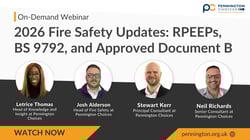 Looking for further expert insights into your requirements under the Fire Safety (Residential Evacuation Plans) (England) Regulations 2025? Catch up on our recent webinar, ‘2026 Fire Safety Updates: RPEEPs, BS 9792, and Approved Document B’, here.
SIBs were created to provide firefighters with building plans and contact details when they arrive at an emergency. But following the Phase 1 Grenfell Tower Inquiry report and the introduction of the Fire Safety (Residential Evacuation Plans) (England) Regulations 2025, their contents now carry a new, crucial layer of responsibility to store up-to-date information about residents who may need help evacuating.
The updated Code of Practice highlights the importance of having RPEEPs stored in a SIB and, crucially, how that information must be maintained over time. Section 5 of the Code, which defines the contents of the Emergency Response Pack, and Section 6, which sets out the maintenance obligations that follow have been updated, which are particularly relevant to your RPEEP and BEEP responsibilities.
The updated Code reflects the Fire Safety (Residential Evacuation Plans) (England) Regulations 2025, which formally require RPEEPs for residents whose ability to evacuate may be compromised. These sit alongside theFire Safety (England) Regulations 2022 and Approved Document B, together forming the framework that makes RPEEP storage in SIBs a legal expectation.
What to include in the Emergency Response Pack?
The full contents of the SIB are described in the Code as the Emergency Response Pack (ERP). Its purpose is to give an incident commander all the information they need in a quick and clear format. Unnecessary or unclear information is actively discouraged, as anything that slows down a firefighter's understanding at the scene has real consequences.
Alongside floor plans, contact details, evacuation strategy, and firefighting facility information, the ERP must now include an RPEEP summary for every resident whose ability to evacuate may be compromised. Rather than including full personal or medical files, the guidance calls for the minimum information necessary. This includes:
- The resident's flat and floor number
- A description of the assistance they are likely to need
- An estimate of how many people would be required to help them evacuate
- A note of whether they have a formal Emergency Evacuation Statement
This information should be presented on a schematic drawing of the building, with each resident assigned to one of two categories so that an incident commander can assess the resources required at a glance. You can find a useful RPEEP template on the London Fire Brigade's website.
RPEEP categories
Category 1 (red): Residents requiring evacuation by three or more people, or who need specialist equipment, such as a stretcher. This includes wheelchair users, bariatric individuals, and those with medical equipment, such as oxygen cylinders. Any telecare provider contact details should also be recorded.
Category 2 (amber): Residents who can be assisted by one or two people with no additional equipment. This includes people with visual, hearing, or cognitive impairments who are mobile, or those who use walking aids. Telecare contact details should be included where relevant.
Residents cannot be compelled to share this information, and their explicit consent is required before any personal details are placed in the SIB. The Responsible Person's (RP) role is to explain the purpose clearly and to provide confidence that the information will be held securely. If a resident declines to share information, that decision must be respected, though the RP should continue to engage residents as part of their ongoing strategy.
To find out whether you are the Responsible Person for your building, head over to our dedicated blog, 'Fire Safety Act 2021: Are you the 'Responsible Person'?', here.
The ERP must also now include the Building Emergency Evacuation Plan (BEEP) as required under Regulation 13 of the Fire Safety (Residential Evacuation Plans) (England) Regulations 2025. The BEEP sets out the overall evacuation arrangements for the building, any instructions to residents about the strategy in place, and confirmation of whether relevant residents exist. Together with the RPEEP summary, this gives the firefighters attending a complete picture of both the building's strategy and the individual needs within it.
Keeping RPEEP information up to date
Storing RPEEP information in the SIB is only useful if the information is accurate and up to date. The Code places a duty on the RP, or a competent person acting on their behalf, to check and update the ERP on a regular, structured basis.
Your maintenance check schedule should look like this:
- After every incident: Confirm all ERP contents are complete, intact, and ready for use.
- Monthly: Check plans and information sheets are present and protected; review RPEEP data against any known changes to residents' needs; inspect the SIB housing, locks, and fixings.
- Annually: Full review of ERP adequacy, scope, detail, and accuracy, including whether RPEEP categories remain appropriate for each resident.
All checks should be recorded in the SIB log book, which forms part of the ERP itself, and maintenance records should align with the building's wider fire safety documentation. Where the RP cannot carry out these checks directly, they may appoint a competent person or a professional keyholding service operating in accordance with BS 7984-1.
What does this mean for Responsible Persons?
The updated Code makes clear that RPEEPs must be a live, operational tool that firefighters will rely on in an emergency. The RP's obligation is to engage residents, obtain consent, record the right information in the right format, store it securely in the SIB, and keep it accurate month by month. Buildings that treat this as a compliance tick box rather than a genuine safety commitment risk the very outcome the Grenfell Inquiry sought to prevent.
The full Code of Practice, including appendices with ERP templates, RPEEP summary forms, schematic examples, and an installation checklist, has been published jointly by the FIA and NFCC and is available from the FIA website.
Looking for further support understanding your RPEEP responsibilities?
Reach out to get in touch with our team of experts who can help you navigate the process.
